
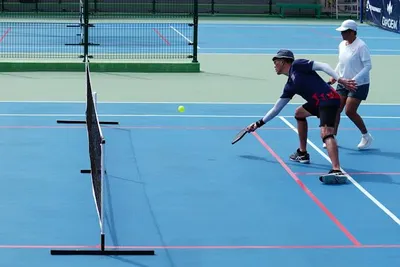
Ask any pickleball player which rule confused them most as a beginner, and the answer is almost always the kitchen. It is the single rule that separates pickleball from other racquet sports. It's also the rule that gives the sport its distinct rhythm of soft, patient dinking rather than nonstop power hitting.
What is the Kitchen?
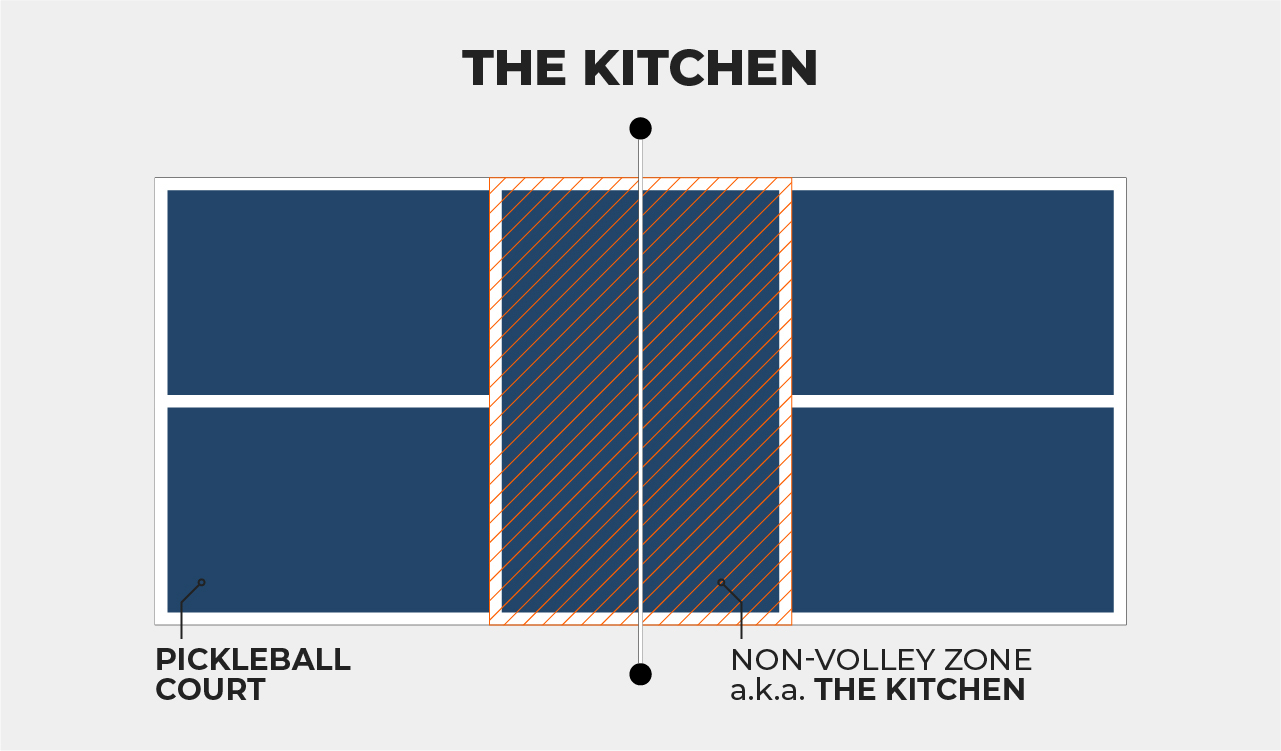
The kitchen, officially called the non-volley zone or NVZ, is the seven-foot strip of court on each side of the net. It runs the full 20-foot width of the court and extends seven feet back from the net line, giving a total depth of 14 feet when both sides are counted together. The net splits the kitchen exactly in half, so each team gets a 20-by-7-foot zone to defend.
The line marking the back edge of the kitchen is called the non-volley zone line, or kitchen line for short. Like every other line on a pickleball court, it is 2 inches wide and counts as part of the zone it borders. For the full rundown of every line on the court and what it governs, see our guide to pickleball court lines.
No Volleys in the Kitchen
In the kitchen, a player cannot hit the ball out of the air (or volley) while any part of their body or paddle is touching the kitchen or its boundary line. The ball must bounce first before it can be played from inside the zone.
Players are allowed to stand in the kitchen at any time. There is no rule against being physically present there. The restriction only applies the moment a player attempts to volley while making contact with the zone, whether that contact comes from a foot, the paddle, a hat that falls off mid-swing, or momentum carrying a player across the line after contact.
Why the Rule Exists
Pickleball's overall court layout is compact, roughly 20 by 44 feet compared to a full tennis court, which means the net is much closer to both players at all times. Without a non-volley zone, a taller or more aggressive player could simply plant themselves at the net and smash every ball out of the air before their opponent had any realistic chance to react. That turns the game into a power contest decided by reach and reflexes alone.
The kitchen forces a bounce and a pause. This gives shorter, older, and less powerful players a genuine chance to compete point for point against bigger, more athletic opponents. It is the single biggest reason pickleball has become the multi-generational, mixed-skill sport it is across gyms and community centers throughout Southeast Asia, where family and friend groups spanning three decades in age regularly share a court.
What Counts as a Fault
A non-volley zone fault, sometimes just called a kitchen violation, happens in a few specific situations.
Situation | Fault? |
|---|---|
Standing in the kitchen, ball bounces, you hit it | No fault. Perfectly legal. |
Volleying the ball while your foot touches the kitchen line | Fault |
Volleying, then your momentum carries you into the kitchen afterward | Fault |
Your hat, sunglasses, or paddle touches the kitchen during a volley | Fault |
Standing outside the kitchen, volleying, and staying outside it | No fault |
The rule is enforced strictly right down to a single loose thread. Tournament-level referees and even casual players in competitive rec games will call a foot fault if a toe grazes the line during a volley, even if the shot itself was clean.
If you're a beginner, read our guide for an in-depth look at Pickleball scoring rules.
Why "the Kitchen" Is the Center of Strategy
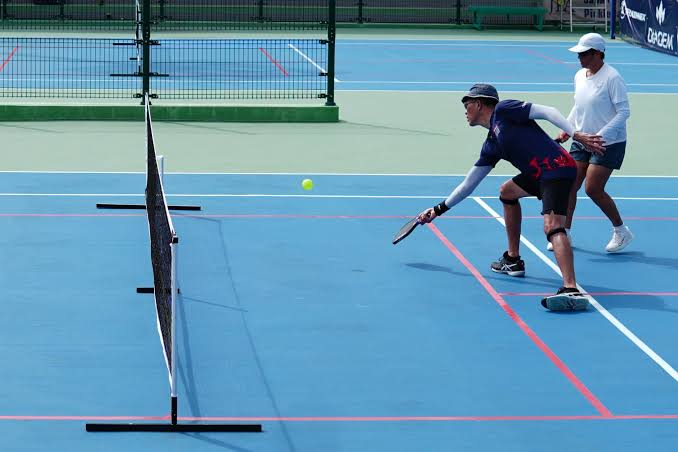
Once players get past the beginner stage, the kitchen line becomes the most contested real estate on the court. Both teams generally want to advance to their own kitchen line as quickly as possible, since standing there gives the best angle to attack and the shortest reaction window to defend.
Getting from the baseline to the kitchen line safely (usually through a soft shot called a third shot drop) is one of the first tactical patterns any improving player has to learn.
Once both teams are at their respective kitchen lines, points are often decided by a slow, patient exchange of soft shots called dinks, each team waiting for the other to pop the ball up high enough to attack. This dinking battle, made possible entirely by the non-volley zone rule, is what gives pickleball its signature look and feel compared to faster-paced racquet sports.
Want to see how a real kitchen battle plays out before you learn it the hard way? Find a court near you at courts.thepicklebase.com and follow @thepicklebase for more rules breakdowns from the region.
Common questions
Can I reach into the kitchen to hit a ball without stepping in?
Yes. As long as no part of your body or paddle touches the kitchen or its line at the moment of contact, you can lean or reach over the zone to volley a ball, as long as you don't fall or step in afterward while touching it during or right after the shot.
Does the kitchen line count as in or out?
The kitchen line is part of the non-volley zone. If your foot touches the line while volleying, that is a fault, the same way a ball landing on the line is considered in.
Is the kitchen a different size indoors or outdoors?
No. The seven-foot non-volley zone is identical on every regulation court, indoors or outdoors. What can differ is the surface material underneath it, which we cover in our indoor vs outdoor courts guide.
What happens if I hit a groundstroke from inside the kitchen and my partner is standing on the line?
Only the player making contact needs to be clear of the zone. A partner standing on the kitchen line during someone else's groundstroke is not a fault, since the rule applies specifically to the player volleying the ball.